
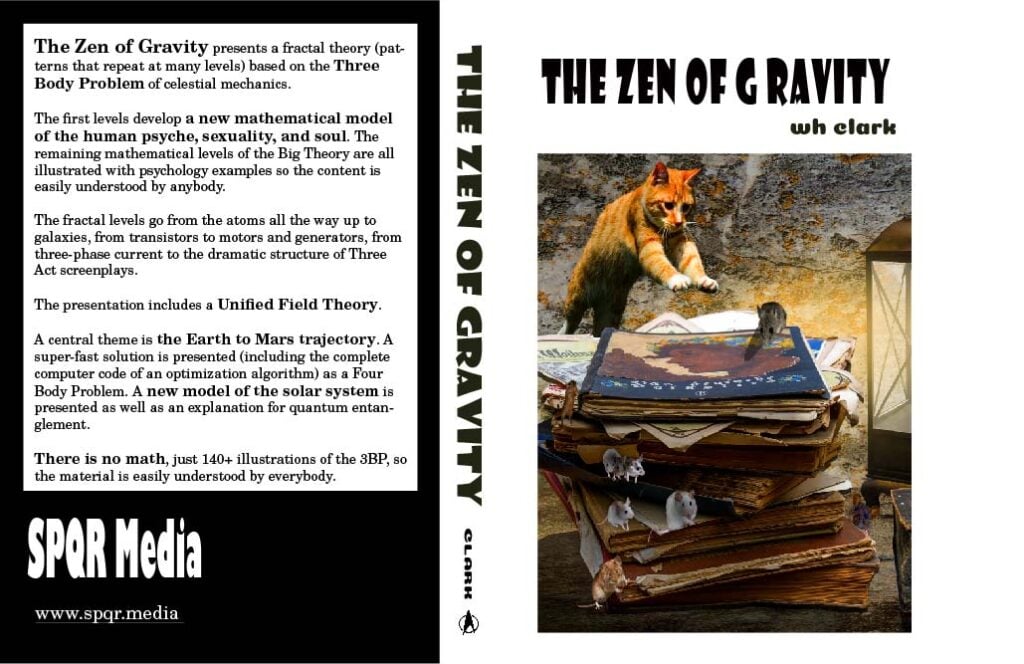
Mathematical psychology is a new field that applies rigorous statistical methods. This book takes a giant leap beyond and applies fundamental, classical mathematics. It achieves this with only diagrams, no math.
Mathematical psychology is based 100% on statistical methods. The results are subject to the biased interpretation of the “experts.” This book proposes a hard-core mathematical model of the psyche, based on orbital mechanics.
About the Book
The psych ideas in the first third of Temporal Mechanics worked so well, I extended the same orbits-to-psychology approach to the rest of the 150+ diagrams.
Absent any formal training in psychology, all I can do is suggest psychology interpretations for different ideas in orbital mechanics. Gravity of the situation. A close fly-by of the object of your greatest desire – which drastically alters your life’s trajectory. If things work out, you’re captured in a parking orbit – which becomes stable and maybe even leads to a crashdown on his/her pad. If not, well, you zoom away into deep, dark space never to be seen again.
The one solid premise uses the Earth to Mars trajectory model to match the Three Act Screenplay structure. I have a MS (and almost a PhD) in orbital mechanics and have written screenplays as a hobby (obsession) for 20 years, with literally hundreds of paid reviews of my projects by Hollywood experts. So I practically have a Master’s in Fine Arts.
The intention of this book is to explain the basic orbital theory using diagrams (which represent a great deal of math, but you don’t need the math to understand the concepts), and to leave it to others to match up psychology ideas. The Google AI Gemini is extremely enthusiastic about the similarities, and blurts out page after page of compelling ideas.
Hopefully mainstream psychology experts will feel likewise. Still, it’s a fun read, and you learn a lot about orbital and celestial mechanics.
Read the PDF Book
You can read the PDF book. (25 megs)
WH Clark, P.E.